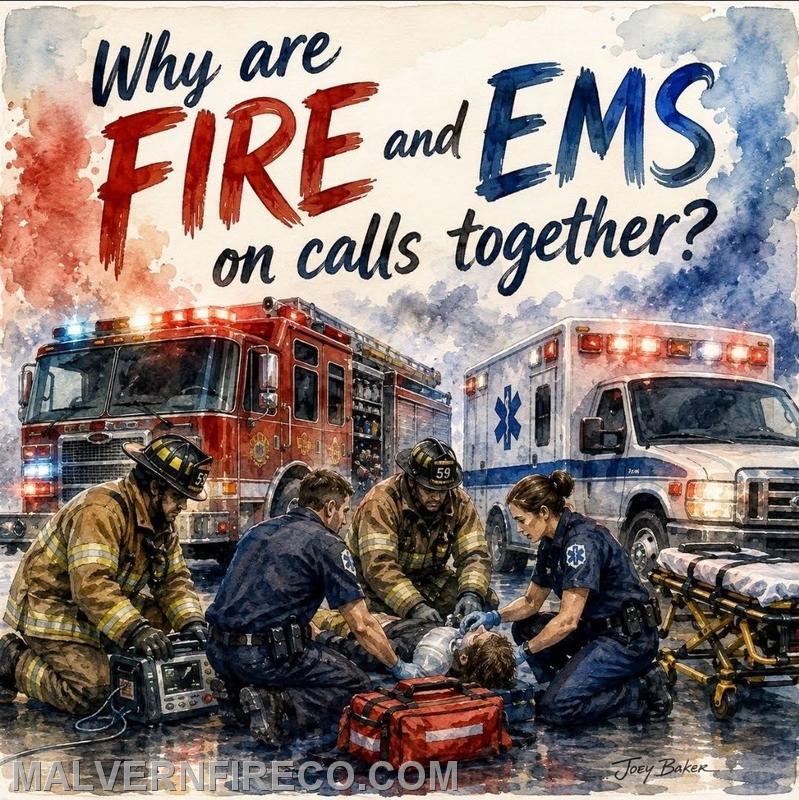
| When you see a fire truck speeding down the road with its lights and siren on, you might assume there’s a fire. But in many communities, fire trucks respond to medical emergencies just as often as—or even more often than—fires.
So why do fire trucks go to EMS calls?
Firefighters Are Trained Medical Responders
Modern firefighters are trained in emergency medical care. Many firefighters are Emergency Medical Responders (EMRs), Emergency Medical Technicians (EMTs), or paramedics.
This means a fire crew can begin providing medical care when they arrive, even if an ambulance is still on the way.
Fire Trucks Can Often Arrive Faster
Fire stations are strategically located throughout communities, allowing fire crews to reach emergencies quickly.
When someone is experiencing a serious medical emergency—such as cardiac arrest, difficulty breathing, a stroke, or severe bleeding—every minute matters.
A fire crew arriving even a few minutes before an ambulance can make a significant difference. Firefighters can assess the patient, begin CPR, use an AED when appropriate, provide oxygen or other emergency care within their training, and prepare the patient for transport.
More People Can Help
Medical emergencies sometimes require several responders.
For example, a patient who has fallen and cannot get up may need multiple firefighters to safely move them. A cardiac arrest may require one person performing chest compressions, another managing an AED, and others assisting with equipment and coordinating the response.
Having a fire crew on scene can provide the additional personnel needed to handle the emergency safely and efficiently.
Fire Trucks Carry Important Medical Equipment
Although fire trucks are designed primarily for firefighting, they also carry equipment used for medical emergencies.
Depending on the department and its level of medical training, a fire apparatus may carry items such as:
AEDs
Oxygen
First-aid supplies
Bleeding-control equipment
Vital-sign monitoring equipment
CPR equipment
Patient-moving and lifting equipment
The exact equipment and capabilities vary from one fire department to another.
What Happens When an Ambulance Arrives?
Firefighters and EMS crews work together.
If an ambulance arrives after the fire crew, firefighters may give the ambulance crew an update on the patient's condition and the care already provided. Depending on the situation, firefighters may continue assisting with patient care, help move the patient to the ambulance, or return to the station when their assistance is no longer needed.
The goal is simple: provide the patient with the fastest and best emergency care possible.
It Doesn't Always Mean There's a Fire
Seeing a fire truck at a medical call can be surprising, but it doesn't necessarily mean there is a fire or that something has gone wrong.
Fire departments are part of the community's emergency-response system. Their job isn't limited to putting out fires—it also includes helping people during medical emergencies, rescues, hazardous situations, and other incidents.
So the next time you see a fire truck racing toward what appears to be a medical emergency, remember: those firefighters may be responding because someone's life could depend on how quickly help arrives. |